Florida's population density
Population
| Historical population |
| Census |
Pop. |
|
%± |
| 1830 |
34,730 |
|
— |
| 1840 |
54,477 |
|
56.9% |
| 1850 |
87,445 |
|
60.5% |
| 1860 |
140,424 |
|
60.6% |
| 1870 |
187,748 |
|
33.7% |
| 1880 |
269,493 |
|
43.5% |
| 1890 |
391,422 |
|
45.2% |
| 1900 |
528,542 |
|
35.0% |
| 1910 |
752,619 |
|
42.4% |
| 1920 |
968,470 |
|
28.7% |
| 1930 |
1,468,211 |
|
51.6% |
| 1940 |
1,897,414 |
|
29.2% |
| 1950 |
2,771,305 |
|
46.1% |
| 1960 |
4,951,560 |
|
78.7% |
| 1970 |
6,789,443 |
|
37.1% |
| 1980 |
9,746,324 |
|
43.6% |
| 1990 |
12,937,926 |
|
32.7% |
| 2000 |
15,982,378 |
|
23.5% |
| 2010 |
18,801,310 |
|
17.6% |
| Est. 2016 |
20,612,439 |
|
9.6% |
Sources: 1910–2010[83]
2016 Estimate[4]
|
The
United States Census Bureau estimates that the population of Florida was 20,271,272 on July 1, 2015, a 7.82% increase since the
2010 United States Census.
[4] The population of Florida in the 2010 census was 18,801,310.
[84] Florida was the seventh fastest-growing state in the U.S. in the 12-month period ending July 1, 2012.
[85] In 2010, the
center of population of Florida was located between
Fort Meade and
Frostproof.
The center of population has moved less than 5 miles (8 km) to the east
and approximately 1 mile (1.6 km) to the north between 1980 and 2010
and has been located in
Polk County since the
1960 census.
[86] The population exceeded 19.7 million by December 2014, surpassing the population of the state of
New York for the first time.
[87]
Florida contains the highest percentage of people over 65 (17%).
[88] There were 186,102 military retirees living in the state in 2008.
[89] About two-thirds of the population was born in another state, the second highest in the U.S.
[90]
In 2010,
illegal immigrants constituted an estimated 5.7% of the population. This was the sixth highest percentage of any state in the U.S.
[91][92] There were an estimated 675,000 illegal immigrants in the state in 2010.
[93]
A 2013 Gallup poll indicated that 47% of the residents agreed that
Florida was the best state to live in. Results in other states ranged
from a low of 18% to a high of 77%.
[94]
Municipalities and metropolitan areas
The legal name in Florida for a city, town or village is
"municipality". In Florida there is no legal difference between towns,
villages and cities.
[95]
In 2012, 75% of the population lived within 10 miles (16 km) of the coastline.
[96]
|
Largest cities or towns in Florida
Source:[97]
|
|
Rank |
Name |
County |
Pop. |
|

Jacksonville
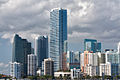
Miami |
1 |
Jacksonville |
Duval |
853,382 |

Tampa
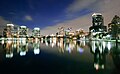
Orlando |
| 2 |
Miami |
Miami-Dade |
430,332 |
| 3 |
Tampa |
Hillsborough |
358,699 |
| 4 |
Orlando |
Orange |
262,372 |
| 5 |
St. Petersburg |
Pinellas |
253,693 |
| 6 |
Hialeah |
Miami-Dade |
235,563 |
| 7 |
Tallahassee |
Leon |
188,107 |
| 8 |
Fort Lauderdale |
Broward |
176,013 |
| 9 |
Port St. Lucie |
St. Lucie |
174,110 |
| 10 |
Cape Coral |
Lee |
169,854 |
A map of Florida showing county names and boundaries.
The largest
metropolitan area in the state as well as the entire southeastern United States is the
Miami metropolitan area, with about 5.8 million people. The
Tampa Bay Area, with over 2.8 million people, is the second largest; the
Orlando metropolitan area, with over 2.2 million people, is the third; and the
Jacksonville metropolitan area, with over 1.3 million people, is fourth.
Florida has 22
Metropolitan Statistical Areas (MSAs) defined by the
United States Office of Management and Budget (OMB). 43 of Florida's 67 counties are in a MSA.
Racial and ethnic makeup
Predominant ancestry in Florida in 2010
Hispanic and Latinos of any race made up 22.5% of the population in 2010.
[101]
As of 2011, 57% of Florida's population younger than age 1 were
minorities (meaning that they had at least one parent who was not
non-Hispanic white).
[102]
Florida is among the three states with the most severe
felony disenfranchisement
laws. Florida requires felons to have completed sentencing, parole
and/or probation, and then seven years later, to apply individually for
restoration of voting privileges. As in other aspects of the criminal
justice system, this law has disproportionate effects for minorities. As
a result, according to
Brent Staples, based on data from
The Sentencing Project,
the effect of Florida's law is such that in 2014 "[m]ore than one in
ten Floridians – and nearly one in four African-American Floridians –
are shut out of the polls because of felony convictions."
[103]
Ancestry groups
In 2010, 6.9% of the population (1,269,765) considered themselves to be of only
American ancestry (regardless of race or ethnicity).
[104][105] Many of these were of English or
Scotch-Irish
descent; however, their families have lived in the state for so long,
that they choose to identify as having "American" ancestry or do not
know their ancestry.
[106][107][108][109][110][111] In the 1980
United States census
the largest ancestry group reported in Florida was English with
2,232,514 Floridians claiming that they were of English or mostly
English American ancestry.
[112] Some of their ancestry went back to the original
thirteen colonies.
As of 2010, those of (non-Hispanic white) European ancestry accounted
for 57.9% of Florida's population. Out of the 57.9%, the largest groups
were 12.0%
German (2,212,391), 10.7%
Irish (1,979,058), 8.8%
English (1,629,832), 6.6%
Italian (1,215,242), 2.8%
Polish (511,229), and 2.7%
French (504,641).
[104][105] White Americans
of all European backgrounds are present in all areas of the state. In
1970, non-Hispanic whites were nearly 80% of Florida's population.
[113] Those of
English and
Irish
ancestry are present in large numbers in all the urban/suburban areas
across the state. Some native white Floridians, especially those who
have descended from long-time Florida families, may refer to themselves
as "
Florida crackers";
others see the term as a derogatory one. Like whites in most of the
other Southern states, they descend mainly from English and
Scots-Irish settlers, as well as some other
British American settlers.
[114]
As of 2010, those of Hispanic or Latino ancestry accounted for 22.5%
(4,223,806) of Florida's population. Out of the 22.5%, the largest
groups were 6.5% (1,213,438)
Cuban, 4.5% (847,550)
Puerto Rican, 3.3% (629,718)
Mexican, and 1.6% (300,414)
Colombian.
[116] Florida's
Hispanic population includes large communities of
Cuban Americans in Miami and Tampa,
Puerto Ricans
in Orlando and Tampa, and Mexican/Central American migrant workers. The
Hispanic community continues to grow more affluent and mobile. As of
2011, 57.0% of Florida's children under the age of 1 belonged to
minority groups.
[117]
Florida has a large and diverse Hispanic population, with Cubans and
Puerto Ricans being the largest groups in the state. Nearly 80% of Cuban
Americans live in Florida, especially South Florida where there is a
long-standing and affluent Cuban community.
[118] Florida has the second largest Puerto Rican population after New York, as well as the fastest-growing in the nation.
[119]
Puerto Ricans are more widespread throughout the state, though the
heaviest concentrations are in the Orlando area of Central Florida.
[120]
As of 2010, those of African ancestry accounted for 16.0% of Florida's population, which includes
African Americans. Out of the 16.0%, 4.0% (741,879) were
West Indian or
Afro-Caribbean American.
[104][105][116] During the early 1900s,
black people made up nearly half of the state's population.
[121]
In response to segregation, disfranchisement and agricultural
depression, many African Americans migrated from Florida to northern
cities in the
Great Migration,
in waves from 1910 to 1940, and again starting in the later 1940s. They
moved for jobs, better education for their children and the chance to
vote and participate in society. By 1960 the proportion of African
Americans in the state had declined to 18%.
[122] Conversely large numbers of northern
whites moved to the state.
[citation needed]
Today, large concentrations of black residents can be found in northern
and central Florida. Aside from blacks descended from African slaves
brought to the US south, there are also large numbers of blacks of
West Indian,
recent African, and
Afro-Latino
immigrant origins, especially in the Miami/South Florida area. In 2010,
Florida had the highest percentage of West Indians in the United
States, with 2.0% (378,926) from
Haitian ancestry, and 1.3% (236,950)
Jamaican.
[123] All other (non-Hispanic) Caribbean nations were well below 0.1% of Florida residents.
[123][124]
As of 2010, those of Asian ancestry accounted for 2.4% of Florida's population.
[104][105]
Languages
20% of Floridians speak Spanish, the second most widely-spoken language.
In 1988 English was affirmed as the state's
official language in the
Florida Constitution.
Spanish is also widely spoken, especially as immigration has continued
from Latin America. Twenty percent of the population speak Spanish as
their first language. Twenty-seven percent of Florida's population
reports speaking a
mother language other than English, and more than 200 first languages other than English are spoken at home in the state.
[125][126]
The most common languages spoken in Florida as a first language in 2010 are:
[125]
- 73% — English
- 20% — Spanish
- 2% — Haitian Creole
- Other languages comprise less than 1% spoken by the state's population
The most common accent throughout Florida is
general American English,
but there are a variety of English-language accents and dialects in
Florida. Southern accents are common in northern Florida. Because of
many migrants from the Northeast who have settled on the east coast of
Florida, many have a northeastern accent. Similarly reflecting
generations of migrants from the Midwest, the population of the west
coast of Florida has a midwestern accent.


